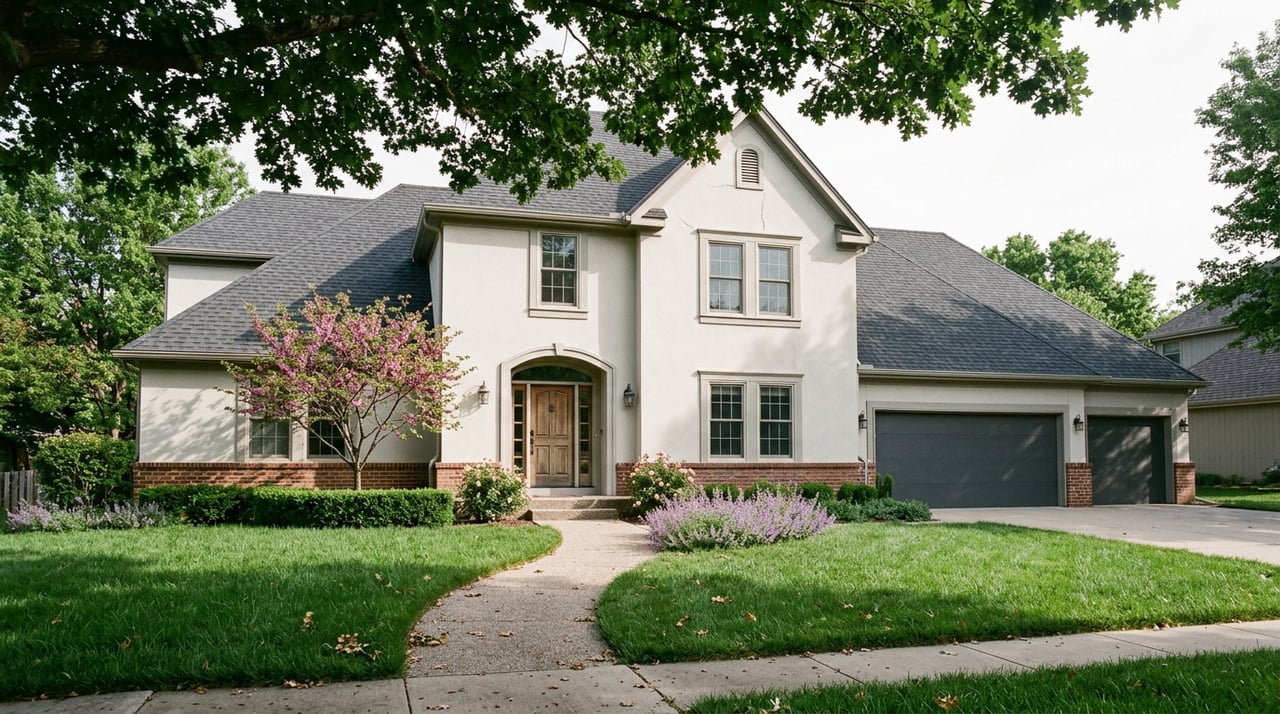
Holladay Home Prices: Why the Median Hides a Split Market
August 20, 2026
August 20, 2026
A buyer comparing Holladay to Cottonwood Heights or Sugar House will eventually land on a single number: the median sale price. It looks like a clean fact. It is not.
As of January 2026, homes across Holladay sold for a median of $768,000, down 3.4 percent from the year before. In the same month, in the same city, homes in the small area known as Historic Holladay sold for a median of $1.3 million, up 63.3 percent year over year. Those two numbers came from the same market, in the same window of time, moving in opposite directions by a wide enough margin that neither one, on its own, describes what a typical Holladay buyer was facing in January.
A median works by finding the middle of whatever sold. When a market is uniform, that middle tells you something real. When a market has quietly split into distinct tiers, the median can blur two different stories into a number that fits neither.
Holladay's split has a mechanical explanation. Land in the older, established pockets near Holladay Boulevard and the Village has become scarce enough that buyers are paying primarily for the lot, with whatever sits on it treated as a bonus or a teardown. Meanwhile the broader citywide figure includes a wider range of housing stock, including condos, townhomes, and homes further from the historic core, which pulled the overall median down even as the scarce, walkable core pulled its own number sharply up. A single sale-to-list comparison across the whole city will flatten that difference. A buyer who only checks the citywide median risks either overpaying in the tight core because they anchored to the lower citywide figure, or walking away from a fair-priced home outside the core because they assumed Holladay pricing had cooled everywhere.
Part of what is driving the historic core's number is land scarcity that shows up most clearly in teardown pricing. Vacant or soon-to-be-vacant lots in Holladay commonly trade in the $700,000 to $1.2 million range before a single permit is pulled, and new custom homes built on those lots typically list between $1.5 million and $3 million, with builds near Cottonwood Country Club or in the foothills above Wasatch Boulevard regularly clearing $4 million. Because Holladay was largely built out by the 1980s, nearly every new home here is an infill project: a 1950s rambler on a quarter-acre coming down to make room for something larger, or a rare vacant parcel near Big Cottonwood Creek getting its first structure.
That land cost is not incidental. It is the floor under every new-construction listing in the city, and it explains why an aging rambler can list at a price that has little to do with its square footage or condition. Buyers evaluating a teardown candidate should plan on 14 to 20 months from lot purchase to move-in for a typical custom build, longer if the design needs variances, plus one to two months of demolition and site prep before that clock even starts.
Holladay incorporated as its own city in 1999, and that single administrative choice still shows up in prices today. Incorporation gave Holladay control over its own zoning rather than leaving those decisions to Salt Lake County, and the city used that control to maintain a slower growth posture that has protected lot sizes from the kind of density pressure reshaping some neighboring areas.
The comparison is measurable. Holladay's typical residential lot runs from 0.20 to 1.5 or more acres.
| City | Typical Lot Size |
|---|---|
| Holladay | 0.20 to 1.5+ acres |
| Cottonwood Heights | 0.10 to 0.35 acres |
| Federal Heights | 0.05 to 0.40 acres |
That extra land buys genuine yard space, room for an accessory dwelling, and a privacy buffer that smaller East Bench lots simply cannot offer. It also means Holladay's land cost floor keeps rising as the surrounding valley continues to build out and buyers who want acreage close to the canyons have fewer competing supply sources to turn to. Land scarcity does not resolve itself. It compounds, which is a large part of why the historic core's price trajectory looks so different from the citywide figure.
The tension between preservation and that same development pressure has played out in public. According to FOX 13, in 2023, a home built in 1879 by Frank and Alwilda Brinton, one of the few remaining adobe structures in the area, faced demolition to make way for eleven new townhomes after the city's planning commission approved the project. FOX 13 quoted a local preservationist describing the home as one that captures the imagination, and reported that the developer maintained that moving or rehabilitating the structure was not financially feasible under current zoning. The dispute did not stop the project, but it is a useful reminder that Holladay's protective instincts run into real limits once a lot's zoning already permits denser use.
While the historic core tightens, an entirely new price band is opening up around Highland Drive and roughly 6100 South. Woodbury Corporation's Holladay Hills is a 57-acre redevelopment of the former Cottonwood Mall site, and it is the largest East Bench redevelopment in more than a decade. In February 2026, the project's office anchor, Kiln Holladay, opened as a 52,000-square-foot flex-office and coworking space, with tenants that include T-Mobile, Intuit, Penn Mutual, and Assos. The Grandeur at Holladay Hills, a residential building with studios, one and two bedroom apartments, and 17 penthouse condos for ownership, opened its first phase in 2024.
Retail and dining have followed the office and residential build-out. Recent additions to the development include:
None of these listings have enough closed sales history yet to sit inside a clean comp set, which means agents and appraisers are still calibrating what a Holladay Hills address is actually worth relative to the established neighborhoods around it. That is a normal, temporary condition for any large new development, but it means a buyer comparing a Holladay Hills unit to a Historic Holladay home or a Walker Lane estate is not comparing three variations on one market. They are comparing three markets that happen to share a zip code.
The practical takeaway is that Holladay pricing needs to be read in tiers, not as one number. At the entry tier, teardown and infill lots are priced almost entirely on land value, with the existing structure contributing little to the number. In the middle tier, established 1980s and 1990s traditionals trade closer to the citywide median and represent the most direct comparison to similarly aged homes in Cottonwood Heights or Millcreek. At the top, the Walker Lane luxury corridor runs from roughly $2 million to $16 million for custom estates on flat, mature parcels, many with Mount Olympus views, and tends to move on its own cycle rather than tracking the broader median at all.
One more detail worth confirming before writing an offer: Holladay is served by the Granite School District, not Canyons, which surprises some buyers coming from Sandy or Draper. Elementary and middle school feeder boundaries also vary by specific street within the city, so confirming the feeder for a particular address is worth doing before, not after, a purchase decision.
Why did Historic Holladay's median rise so much while the city's overall median fell? The two figures measure different pools of homes. Historic Holladay's small, land-scarce inventory skews the number upward when a handful of high-value sales close, while the citywide figure includes a much broader mix of housing types and locations that pulled the overall median down over the same period.
Is a teardown lot always a good value? Not automatically. The lot price is only the starting point. Buyers need to budget for demolition, an extended design and permitting timeline, and a construction cost that typically starts around $1.5 million before deciding whether a specific parcel pencils out.
Does Holladay Hills change what a home in the older neighborhoods is worth? Not directly, but it changes the context. A new lifestyle anchor with dining, office space, and retail tends to add value to the surrounding area over time, even though the new development's own comps are still being established.
If you are trying to figure out which Holladay tier actually fits your budget and your plans, or you are weighing a teardown lot against something already built, that is exactly the kind of pricing question worth working through with someone who tracks this market closely. The Lori and Lisa Sell Team can walk you through current Holladay inventory tier by tier and help you read a listing price for what it actually reflects. Get a Free Home Valuation to start the conversation.
This article is general information, not legal, tax or financial advice. Consult a qualified professional about your situation.
Stay up to date on the latest real estate trends.
With 44+ years of combined experience, Lori Hendry and Lisa Woodbury deliver a seamless, team-based approach to buying and selling. Through strategic marketing, expert guidance, and strong negotiation, they help clients achieve the best possible results with confidence.